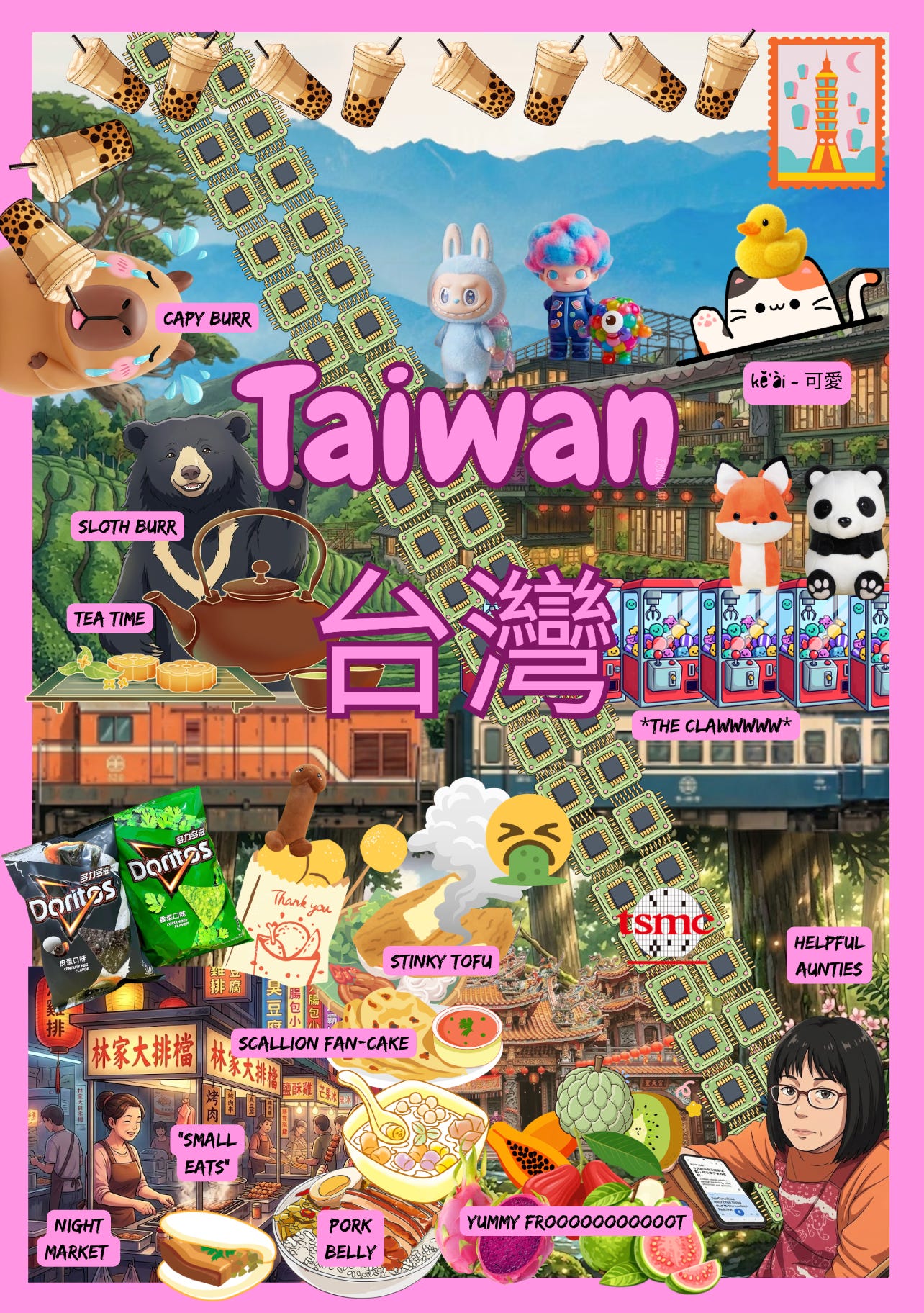
#3. Cute Things
A Taiwanese master class

“Dulan’s the type of idyllic little town you end up in when all you want to do is surf and make cute art.”
Rob, the middle-aged British expat had just sat down across the breakfast table with me, stirring powdered milk into his morning tea.
“You mean it’s the most remote place in this country that you can run away from serious work?” I jabbed.
“No, because all the serious shit in the world makes surfing and cute shit the most important thing you CAN do.”
—
God do I love this place.
Is it the fact that it looks like a dumpy little Taiwanese town at first glance? Maybe.
There’s not really anything here except for a black sand beach and an abandoned sugar factory. And nobody really speaks english except for a ragtag group of introvert surfers zipping around on rickety Honda scooters.
The tourist flow is mostly Taiwanese families, and the extent of nightlife consists of a 7-11 that’s open late and a bar that opens about once a week when the owner Brian feels like it.
But man is it cute.
Nestled into this town are the nooks and crannies that explode with color and charm. Pretty murals all over the place, cute little signage, boutiques and galleries from indigenous artists, and gorgeous karst mountains that butt up against the little coast and frame the whole thing like some Hawaiian postcard.


So naturally it felt like the perfect spot for a little surf retreat for me, while Hannah was diving for aliens (nudibranches) in Raja Ampat... which she found, btw.
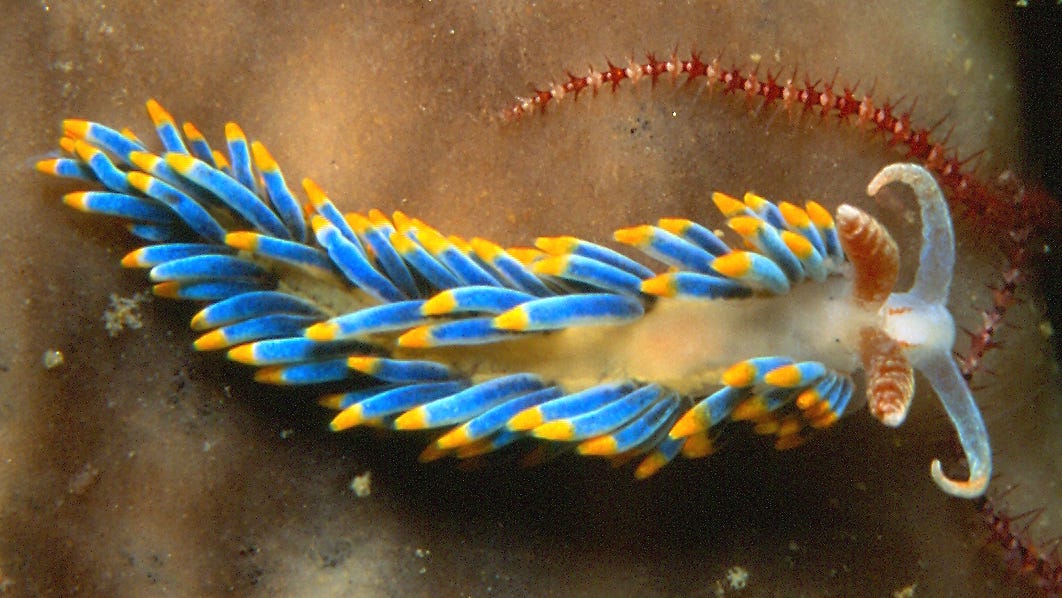
And so the lovebirds reunited, and we had ourselves quite a time on Taiwan’s bohemian coast. We missed valentine’s day, so we had to make up for lost time. We caught some waves, enjoyed some delicious tea (Taiwan has the best Oolong in the world), savored some indigenous Ami cuisine, saw some art, scored treats at 7-11, and even bought fireworks for Chinese new year.
That was our first 2 days back together. And with only 8 more to go before we needed to zip, we had to get on the road to do our Tour de Taiwan.
But never would we have expected that it would be so...
CUTE.
It feels strange to try to summarize the experience of a country in a single idea, let alone a single word. Cultures are so multi-faceted, and even contradictory. How can one word sum it up? Well here’s how.
CUTE as in their nature, like our trip to Alishan National park, where every square meter of trail is laid with adorable wooden bridges cut across ancient cedar and cypress forests, flowing with little creeks and blooming with cherry blossoms;
where old narrow-gauge steam trains still carve up and down the mountains on old logging lines (the train is an engineering marvel, btw—built by Japanese in 1912, uses switchbacks, spirals, and a shay locomotive to climb the 2000 meters from Taiwan’s plains to the cool forest highlands) and where the residents of homes lining the tracks don’t get angry at the loud squeaky train as it rumbles past, but rather run out to wave at the cars as they pass;
where the bus drivers never run out of fresh tea as they whip around the windy mountain roads;
where cute little figurines decorate the national park, paying homage to the logging industry that gave Taiwanese hardwoods the global recognition they deserve.


CUTE as in the little villages. We were in Shifen there for the Lantern Festival, where people release lanterns with wishes for the new year (some of which burst into a ball of flames within moments). We saw dogs with dietary preference signs (they often wander around town, and expect neighbors feed them). We visited cute villages like Hutong, which is feline-themed and occupied by hundreds of resident cats, and Jiufen, a former gold-mining outpost whose narrow streets and lantern-lit paths were an inspiration for Hayao Miyazaki’s Spirited Away.


CUTE as in the food culture, where baked goods are served out of the back of vans, ice cream comes in adorably weird soft served flavors (fish head casserole, anyone?), tea is served in artistic dioramas with animal figurines, night market food is often round and squishy (just like boba and plush dolls—notice a pattern?), and we even splurged on a nice dinner that told a story of taiwanese culture through food courses via origami fortune teller.


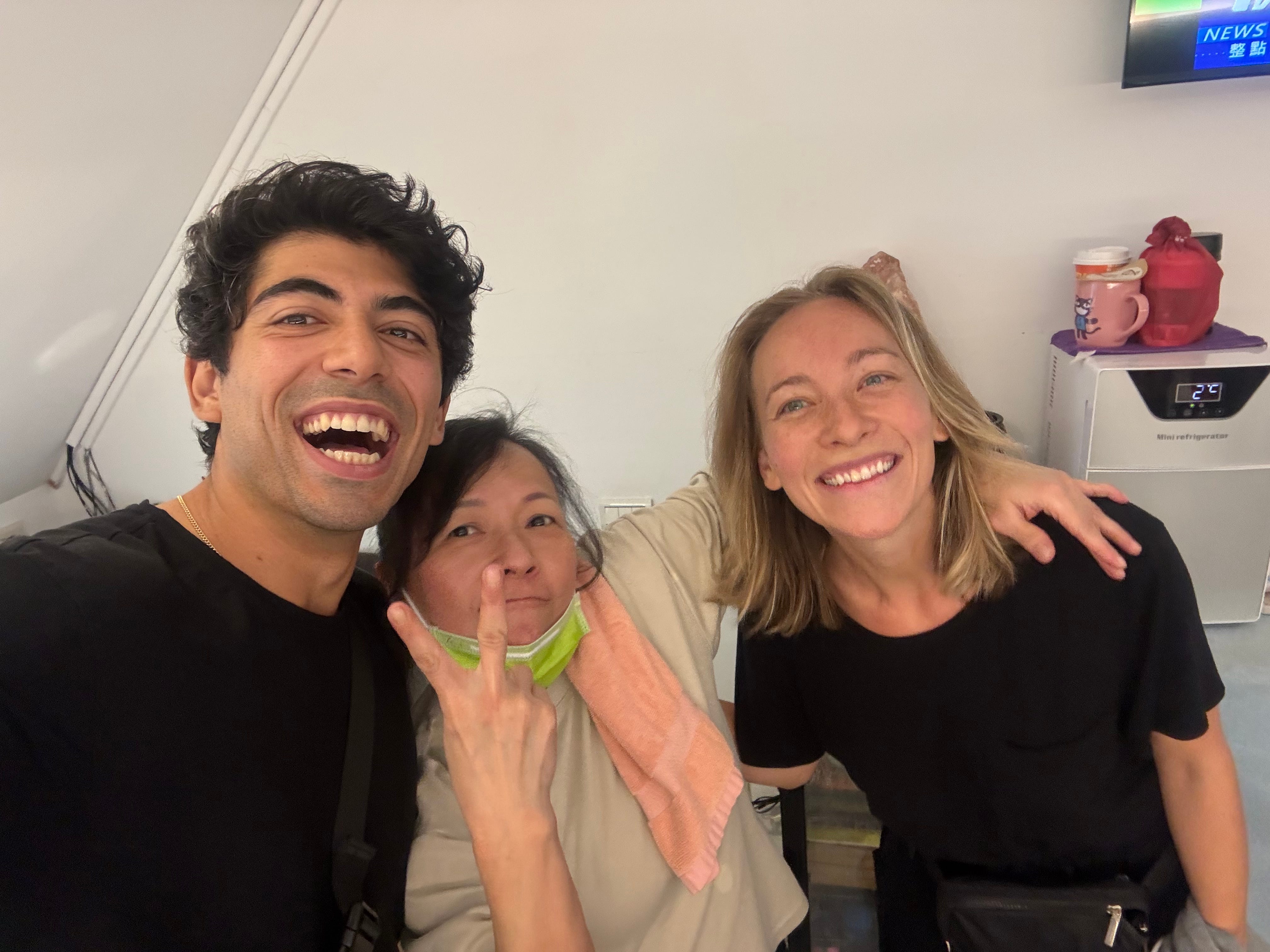
CUTE as in the little old ladies that you can always rely on to show you how to properly eat food, properly speak mandarin, or just to find something mundane to laugh about.


CUTE as in the hot springs, where everyone loves getting warm and cozy, whether it’s in public, on a hike in nature, or in the comfort of your own hotel (the Beitou neighborhood of taipei literally piped hot spring water into our hotel room for a little private spa day!)


CUTE as in the plush culture, where everyone walks around with adorable little dolls or trinkets that they buy from stores or score from claw machines (highest claw machines per capita nation!)—Hannah and I tried our luck and had to call customer support when Hannah stuck her hand in the thing causing a malfunction (no surprise here...). But, we won in the end!


One store even made a literal altar for a beloved cartoon and plush character (Bugcat Capoo, for my weebs out there).
CUTE as in infrastructure, where even manhole covers have woodland and ocean scene scapes, local trains have great aesthetic, the national train system employs feline gate agents (with official scarves!), the roads have mallard mosaics, and even the trash is nice and orderly. Their garbage trucks even play 8-bit classical music as they drive through the streets.


CUTENESS OVERLOAD.
And to be clear, it’s all rainbows and unicorns here. It’s a rare kind of cute that holds its fair share of contradictions. We still felt a certain courteous, respectful distance among locals. Their cities are still gray and their buildings (country-wide) still look more like drab concrete and tile boxes rather than Studio Ghibli wonderscapes.
Almost like their cute culture is built on top of something more complicated.
Why is that?
Time for (short) history class.
Taiwanese culture, like any culture, has emerged from the interaction various identities that have influenced the island.
It started with its Austronesian indigenous peoples who inhabited the island for millennia before it became a point of interest for colonial powers. These cultures, like the Ami people we met in Dulan, represent about 2.5% of Taiwanese people, but their characteristic warmth, resilience, and colorful crafts are the undertone of Taiwan’s distinct culture from mainland china.
Crazy unrelated side note: Taiwan is likely the ethnic origin of all Austronesian people (those inhabiting the islands of the Pacific, Southeast Asia, and the Indian ocean including madagascar!). This “Out of Taiwan” theory is based on linguistics (9 out of 10 austronesian root languages are found among Taiwanese indigenous poeople) and engineering (they were the first to develop long-haul outrigger boats).

Starting in the 17th century, large waves of Hoklo and Hakka immigrants from Fujian and Guangdong (China) crossed the strait, permanently shifting the island’s demographics and establishing a distinct Han-Taiwanese agrarian society. Following the Qing Dynasty’s defeat in the First Sino-Japanese War (1895), Taiwan was ceded to Japan, marking a fifty-year colonial period that brought rapid modernization, industrialization, infrastructure (like the rail system) and a centralized education system.
At the end of WWII in 1945, control of Taiwan was handed to the Republic of China (ROC). However, after the ROC lost the Chinese Civil War in 1949 to Mao Zedong’s communist uprising, the ROC government fled to Taiwan, bringing two million people (including an entire military).
In an attempt to rebuild power, the ROC imposed one of the world’s longest periods of martial law (38+ years), known as the White Terror. This era was defined by the systematic suppression of political dissent and the “re-education” of the local population. It wasn’t until a pro-democracy movement in the late 1980s, paired with the “Taiwan Miracle” (land reform + education —> industrialization —> export economy) that has turned them into the vibrant, pluralistic, and globalized tech hub that it is today.
So where does the cuteness come from?
Taiwan’s culture of cuteness (kě'ài - 可愛) evolved as a Japanese-influenced survival mechanism to recover from the White Terror, adjust to the rapid transition to a hyper-competitive industrialized culture, and cope with the constant threat of their big red neighbor.
Cuteness became a way to humanize power. Influenced by Japanese Kawaii culture, Taiwan began using cute mascots to enforce rules, and presidents have even launched plush dolls to signal commitment to safety and security.


Taiwan’s rapid economic rise in the 80s and 90s also created a high-pressure, hyper-competitive society. How else to get through it than surrounding your everyday life with cuteness comforts? This is what sociologists refer to as a “Healing Culture” (Taiwanese call it liáoyù - 療癒, and there’s lots of research on it).
Plush dolls, cat cafes, mascots on the subway, warm boba with squishy pearls can be seen as a therapeutic practices. Cuteness serves as both a psychological buffer against geopolitical tension and a deliberate choice to maintain community warmth and individual joy in an increasingly rigid and unpredictable world.
The result?
Taiwan is the 4th safest country on earth, an industrial powerhouse (semiconductors, bicycles, computers), even a cultural exporter (boba, oolong tea, etc.), and has forged incredible diplomatic relations with most of the world. Despite being claimed by the second largest superpower in the world (a mere 112 miles away), it somehow has negotiated its protection from the FIRST largest superpower in the world.
Not bad for a nation that can’t even get recognized by the UN.
Cuteness, likability (and semiconductors!) go a long way.
A lesson for turbulent times.
As I write this, the US, Israel, and Iran are getting into a ballistic pissing contest that seems like it could escalate into a large regional conflict.
But aside from messing up Hannah’s travel plans (the Abu Dhabi layover seems less glamorous when missile shrapnel keeps pummeling the airport), it also challenges us to take a page from Taiwanese culture.
When everything is so, so serious, maybe the best way to live is surrounding yourself by things that are soft and squishy, doing something cute for the people you love, and finding a way to pass that feeling forward.
You could call it coddling, you could call it idealism, you could call it burying your head in the sand. But one thing I know for sure about these Taiwanese aunties is that I haven’t seen a single one of them I’d call a coddled wimp.
The modern era requires modern survival mechanisms. The Taiwanese call theirs Xiao Que Xing (borrowed from Haruki Murakami).
It means “tiny but certain happiness.”
Maybe it’s time we found ours.
With cuteness,
Jordan and Hannah